

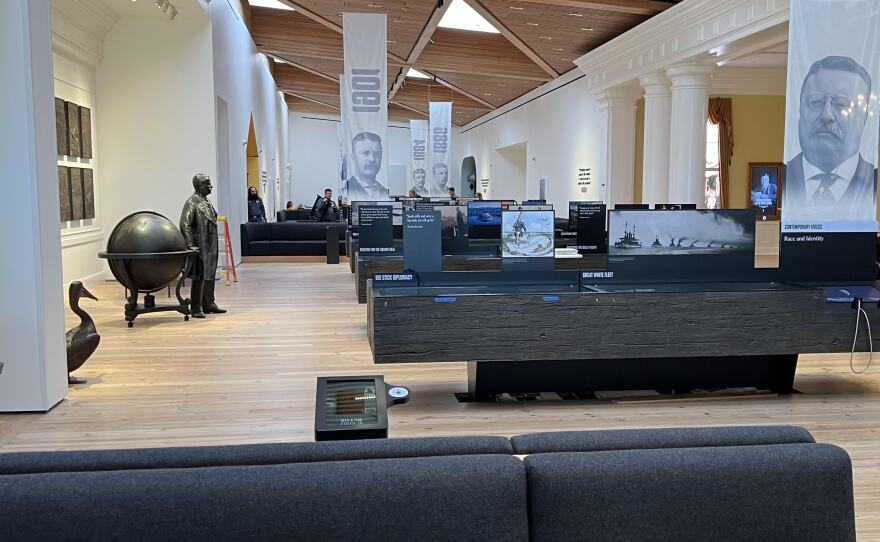
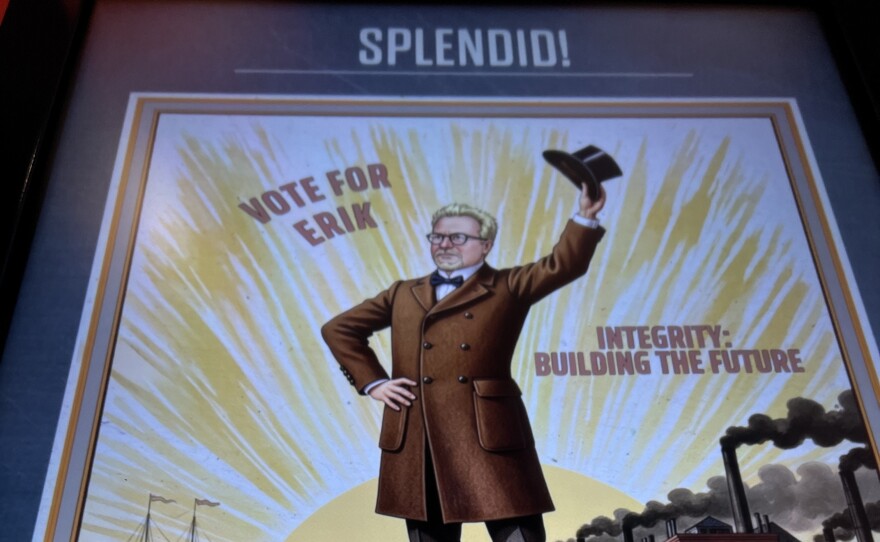

If you ever had the urge to “talk” to a dead president, you can, at the newly-opened Theodore Roosevelt Presidential Library in Medora, North Dakota. Or at least you can interact with an AI version, as I did during a grand tour of the facility, which was built into a butte overlooking the namesake national park.
I asked AI Teddy about his feelings for North Dakota. “He” replied, “The open skies and cold wind worked the sorrow out of my bones. That lonely prairie made me, in many ways, the man the country came to know.”

As a young man of affluence from Oyster Bay, New York, Roosevelt was a sickly and bookish fellow. He sent himself to rugged western North Dakota to toughen up.
It was also following the sudden deaths of his wife and mother on the same day in 1884. Matt Briney, Theodore Roosevelt Presidential Library Chief Communication Officer, said Roosevelt came to North Dakota to heal through hard work. “He writes in his journal an X in that day and he says the light has gone out in my life. He never met the same skills as ranchers or cowboys, but he tried.” In fact, the 26-year-old Roosevelt transformed into a physically fit hunter of bison and mostly credible cattle rancher. Briney said, “He got in the arena and so I think North Dakotans today still feel such an affinity to him.”
Roosevelt credited the hard work of his three years in western North Dakota with giving him the moxie to become President of the United States. It also sparked his passion for conservation. North Dakota's $450 million crown jewel finally opened 140 years later following three years of construction.
Library CEO Ed O'Keefe spoke enthusiastically at a July 4th, 2026 opening ceremony on the library grounds, quoting the “Conservation President.” He said, “The Theodore Roosevelt Presidential Library is for your children, your children's children, and all who come after you!”
At the opening ceremony, Theodore Roosevelt V credited the North Dakota Badlands for healing and shaping his great-great-grandfather. But he also acknowledged the people who originally lived on the land where the library stands. He said, “Long before Theodore Roosevelt came west, this was and remains the homeland of the MHA nation.” MHA stands for the Mandan, Hidatsa, and Arikara Nation, also known as the three affiliated tribes of North Dakota. Some members performed a traditional land blessing of the library’s grounds. “We are deeply grateful for our partnership and for the generosity, wisdom, and living traditions that they bring to this institution. A library devoted to leadership and citizenship must tell the truth about the land on which it stands. The truth is President Theodore Roosevelt promoted land deals that exploited indigenous people,” Roosevelt V said.
President Roosevelt’s controversial legacy can be seen in a 1939 bronze equestrian statue donated to the library by the American Museum of Natural History in New York. Roosevelt rides atop a horse while Native and African American men walk alongside him. Some see this depicting racial hierarchy and white supremacy.
Roosevelt said a lot of racist things during his time. Museum officials and the consultants advising them say they're not trying to lionize TR. They intend to tell the story of his flaws as well.

Prairie Rose Seminole of the MHA Nation and key member of the library’s Native American Advisory Council said the question of what to do with the statue is a difficult one to answer. “If we can display the ugly and those parts of our history that are not the easiest to tell in a context that we can learn from, I think that it could be done, right? But then there's another part of me that feels like we should melt this down and, you know, make something more valuable,” Seminole said.
Library officials said they will consult with tribes and historians to figure out whether the statue could be recontextualized as an exhibit.

As I neared the end of my library tour, I stopped at a display of presidents and celebrities quoting Theodore Roosevelt, including Joe Biden. Biden read: “This country will not be a good place for any of us to live in, unless we make it a good place for all of us to live in.”
Library designers hope the bipartisan echoes of living presidents and a long-past chief executive who said to stop being a critic and take action will inspire visitors to heal our divisions and enact positive change in themselves and their communities.
For the Upper Midwest Newsroom, I'm Erik Deatherage in western North Dakota.